_edited.png)
Things to know when using Urea fertilizer
1. Urea fertilizer is not always the primary source of nitrogen fertilizer for crops.
Urea was first synthesized by the German chemist Friedrich Wöhler in 1828. Before that time, organic nitrogen sources such as urine, human waste, manure, and decomposed organic matter were the only sources of this important macronutrient in the soil.
Currently, there are many forms of synthetic fertilizers that provide important nitrogen for plants, such as ammonium nitrate (NH4NO3) containing 33-35% pure N, ammonium sulfate (also known as SA fertilizer) containing 20-21% pure N, etc.
However, urea fertilizer has a very high total N content of up to 46%, making it more economically efficient and preferred. Approximately 90% of the synthetic urea produced today is for fertilizer use.
2. Impurities in fertilizers and improper use of urea fertilizer can harm crops
A common impurity in urea fertilizer is biuret (C2H5N3O2), which is produced during the urea manufacturing process. When accumulated at high concentrations, biuret can interfere with nitrogen metabolism and hinder the formation of plant proteins, affecting plant growth and development.

Although biuret can be broken down by microorganisms in the soil, this process is relatively slow, and when biuret remains for a long time, it becomes toxic to plants. According to Vietnamese standards, the biuret content in urea fertilizer should not exceed 1.5%.
As with any nitrogen source, when used in excessively high amounts, urea itself can harm plants: it can impair or completely hinder seed germination, and too much nitrogen can cause plant burn.
3. Bacteria in the soil break down urea fertilizer into a form that is easily absorbed by plants
The first step in providing nitrogen in urea (CH4N2O) to plants is to convert it into ammonia (NH3) or ammonium ions (NH4+) and bicarbonate ions (HCO3-).
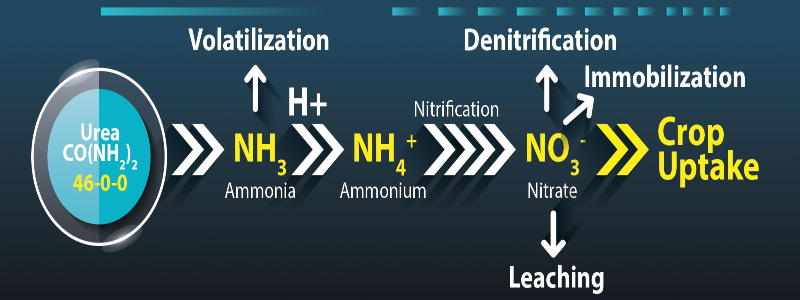
Naturally, soil bacteria—commonly known as ammonia-oxidizing bacteria (AOBs)—accelerate this process through the catalysis of the soil-derived enzyme urease.
Then, through a process called nitrification, ammonia is oxidized to nitrite. Nitrite is oxidized to nitrate by nitrite-oxidizing bacteria (NOBs).
Both ammonia and nitrate are among the most readily absorbed forms of nitrogen by plants.
4. Urea fertilizer affects soil pH
During nitrification, there is an increase in the number of free hydrogen ions (H+) in the soil, creating acidity. Additionally, when plants absorb ammonium ions (NH4+), they also release hydrogen ions into the soil.
A study was conducted to examine the change in soil acidity due to long-term urea application and its effect on soil properties. The experiment involved applying nitrogen fertilizer in the form of urea (46% N) at 0, 60, 120, and 180 kg N/ha to maize grown on Alfisol soil.
After 4 years of annual urea application, the soil became more acidic than the control plots without additional urea application. The degree of soil acidification was significantly greater with more than 120 kg N/ha applied compared to no application, or 60 kg N/ha with urea application.
Lower pH values were observed starting from the second cropping season, and by the end of the fourth cropping season, the pH had decreased by 0.87 units across the plots receiving 180 kg N/ha. Urea application also significantly reduced the amount of exchangeable bases (Ca, Mg) in the soil. Compared to the control group, Ca and Mg in the soil decreased by 13% and 28%, respectively, in the urea-treated plots.
This study shows that long-term annual urea application leads to soil acidification and a reduction in exchangeable bases (Ca and Mg). Furthermore, the study also indicates that annual burning of straw and crop residues on the soil is unlikely to reduce the acidification associated with urea application.
Therefore, measures to neutralize the acidity in soils regularly treated with high concentrations of urea fertilizer are necessary to create a balanced pH environment for crops.
5. Healthy plant growth depends on quality, not quantity
As mentioned above, prolonged use of excessive urea and nitrogen can have adverse effects on crops. It can also have negative impacts on the surrounding environment: nitrates are highly mobile in water, and the leaching of fertilizers from agricultural production will harm water sources.

Therefore, although urea fertilizer is generally a reasonable choice in terms of climate and economics, caution is needed in its use to maximize crop benefits while minimizing environmental impact.

